

November 2025
OBB at the Soc. for Neuro-Oncology conference
As a fourth-year medical student and board member of OurBrainBank (OBB), I recently attended the Society for Neuro-Oncology (SNO) annual meeting in Honolulu with the OBB team. The experience underscored the growing impact that patient-led research initiatives are having on the glioblastoma (GBM) research landscape.
OBB presented two abstracts that generated strong interest from the neuro-oncology community. Our first abstract, “Disparities in Tumor Treating Fields (TTFields) Awareness, Access, and Patient Experience,” was selected for a rapid oral presentation and poster. Our second abstract, “Disparities in Glioblastoma Care: A National Survey on Access to Trials, Testing, and Informed Decision-Making,” received the SNO Health Disparities and Quality Improvement Award, highlighting the importance of this work in addressing critical gaps in GBM care equity.
The SNO community group meeting offered a valuable forum to discuss disparities in clinical trial access across different patient populations. Our survey showed that patients treated at National Cancer Institute–designated cancer centers, typically larger academic centers, were significantly more likely to be offered clinical trials than those treated elsewhere. These data resonated strongly with clinicians who had long suspected such disparities but lacked nationwide evidence. To our knowledge, this is the first nationwide survey to document these inequities in the GBM population, helping turn anecdotal observations into actionable evidence.
The community group expressed support for helping disseminate the next iteration of our survey. This potential collaboration is particularly important because our survey population skewed younger, more urban, and more educated than the broader GBM community. By partnering with the SNO community group, we hope to reach more underserved and rural populations who may not receive care at major academic centers, and in doing so, capture a more representative picture of the challenges facing people living with GBM and their caregivers.
During these discussions, we also explored solutions to address barriers faced by rural patients in accessing clinical trials. The group highlighted the potential of telemedicine to enable patients in remote areas to participate without the burden of frequent long-distance travel. We also discussed OBB’s new initiative to assess quality of life directly from mobile phone data, an approach that could provide both meaningful endpoints for clinical trials and support remote monitoring for side effects and disease progression.
Among other notable presentations we saw, Dr. David Black from Mayo Clinic shared compelling work on using AI to create comprehensive yet accessible summaries of GBM patients’ medical journeys. His system synthesizes complex medical records into easily understood narratives that include prior treatment decisions, adverse reactions, scan findings, and illness trajectory. This kind of patient-centered innovation aligns closely with OBB’s mission to empower patients with better information and tools to navigate their care.
Overall, the conference reinforced the vital role that patient-driven research plays in advancing GBM care. It was incredibly energizing to see how OBB’s work is not only documenting problems but also driving conversations and initiatives that could improve access to care and quality of life for GBM patients across diverse communities.
—Jacob Ellen, Harvard Medical School student and OurBrainBank board member, November 2025
More information:
Learn more about OurDataBank
OurBrainBank presented our GBM Disparities Survey at SNO and WFNOS, Honolulu, Hawaii, November 19-23, 2025
“Disparities in Tumor Treating Fields (TTFields) Awareness, Access, and Patient Experience: Findings from a National GBM Survey” (Abstract DISP-34)
Oral Session: Friday, November 21, 11:30am-12:30pm
Poster Session: Saturday, November 22, 11:45am-1:05pm
“Disparities in Glioblastoma Care: A National Survey on Access to Trials, Testing, and Informed Decision-Making” (Abstract QOL-35)
Oral Presentation: Saturday, November 22, 4:30-5:30pm
Selected for the 2025 Health Disparities & Quality Improvement Award
LATEST NEWS.
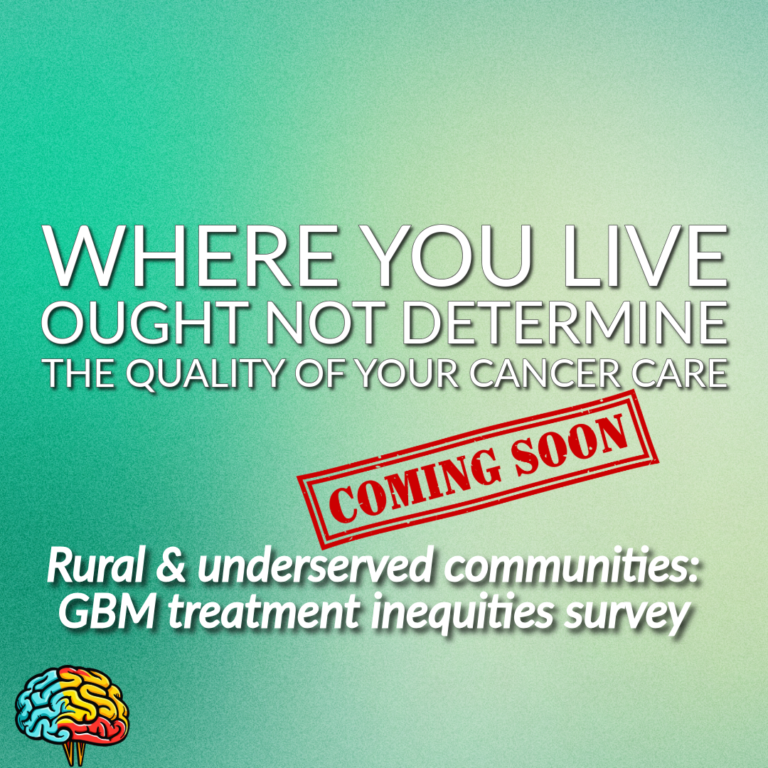
Help us with a new survey on GBM treatment disparities for people in rural areas
We want to reach patients missing from the data, so we’re expanding our national disparities research to reach rural and underserved families often left out of the picture.
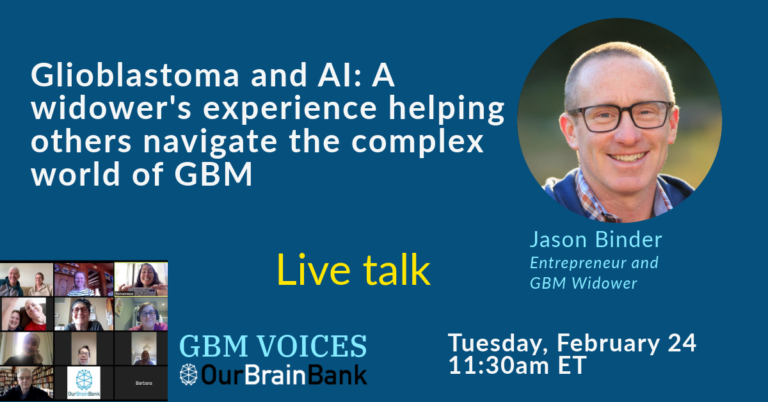
Live Zoom chat with Jason Binder: GBM & AI
Jason Binder is a father of five and healthcare entrepreneur whose wife, Tracy, died of glioblastoma in 2025. During her illness, he built an AI tool…
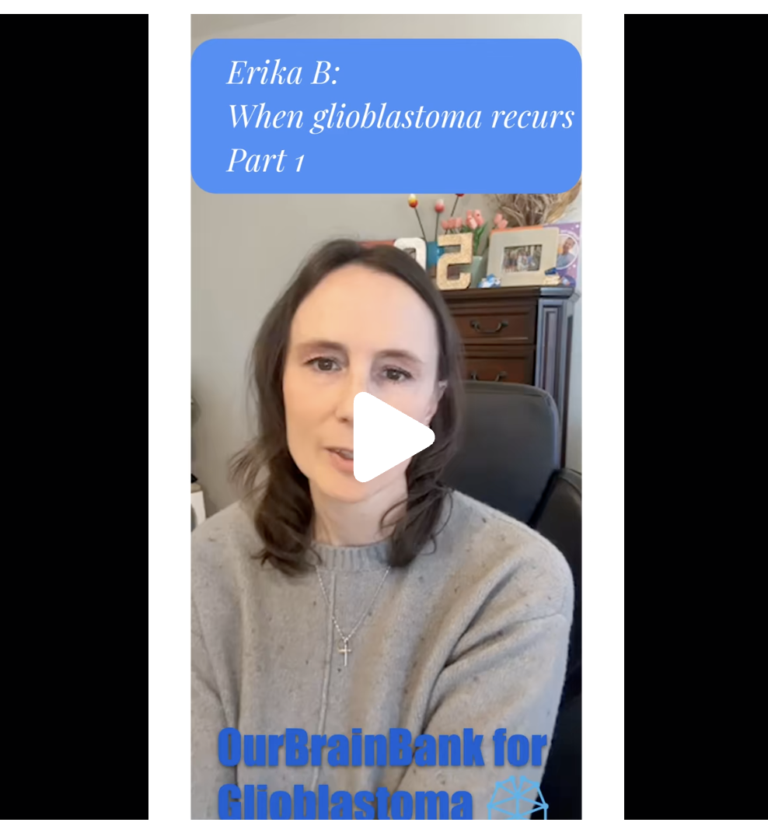
OurStoryBank: Erika talks about recurrence
Erika was thriving as a GBM survivor until it came back. She’s finding out that the options for recurrent GBM are few.
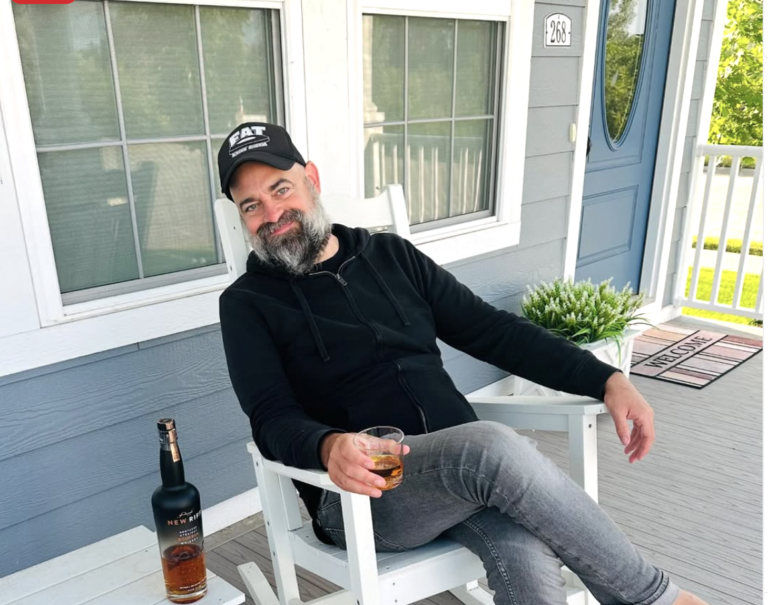
Adam Hayden: writer, philosopher, husband, father and long-term glioblastoma survivor (1982-2025)
Remembering Adam Hayden, a giant in the glioblastoma community (1982-2025)
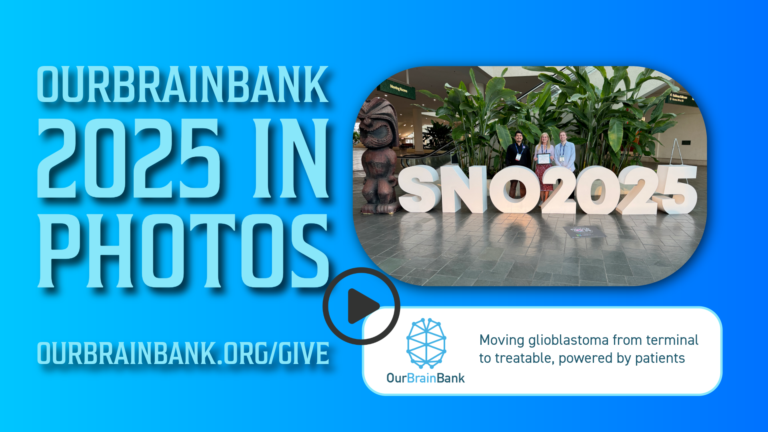
OurBrainBank: 2025 in photos & videos
In 2025 we met with people living with GBM and their care partners, traveled to conferences, and began to tell the world about our GBM Disparities Survey.
LATEST NEWS.
Help us with a new survey on GBM treatment disparities for people in rural areas
We want to reach patients missing from the data, so we’re expanding our national disparities research to reach rural and underserved families often left out of the picture.
Live Zoom chat with Jason Binder: GBM & AI
Jason Binder is a father of five and healthcare entrepreneur whose wife, Tracy, died of glioblastoma in 2025. During her illness, he built an AI tool…
OurStoryBank: Erika talks about recurrence
Erika was thriving as a GBM survivor until it came back. She’s finding out that the options for recurrent GBM are few.
Adam Hayden: writer, philosopher, husband, father and long-term glioblastoma survivor (1982-2025)
Remembering Adam Hayden, a giant in the glioblastoma community (1982-2025)
OurBrainBank: 2025 in photos & videos
In 2025 we met with people living with GBM and their care partners, traveled to conferences, and began to tell the world about our GBM Disparities Survey.