Glioblastoma Bill of Rights
Eight practical rights to help patients and care partners ask questions, understand options, and advocate for high-quality care.

Eight practical rights to help patients and care partners ask questions, understand options, and advocate for high-quality care.
A custom plan developed before initial treatment — tailored to you and your tumor. Discussion of all options and every FDA-approved treatment (including Tumor Treating Fields).
Tumor biomarker testing (individual makeup, including mutations) before treatment begins. Fast-tracked analysis. Tissue from initial surgery frozen for potential use.
A second opinion before treatment and again at any point. A good doctor will welcome this and a good healthcare system will enable it.
Up-to-date, accurate, and personalized information about emerging treatments. Help with related travel and expenses. Clinical trials offered at diagnosis and if the tumor recurs.
Tumor removed by a neuro-surgeon. Treatment guided by a neuro-oncologist. Access to specialists like radiation oncologists and neuro-pathologists. Coordinated and communicative care team.
Psychological help (care partners too) and support groups. Palliative care — to ensure good quality of life, minimize suffering, and manage pain. Hospice care — comfort rather than curative treatment (when appropriate)
Access to affordable and effective treatment. Transparency about outcomes. Help with insurance, benefits, housing, and transportation. Information about workplace rights (short and long-term disability, accommodations).
Ease in obtaining health records — including fast-tracked MRI results — and transporting own data. Ability to donate data and tissue for research.
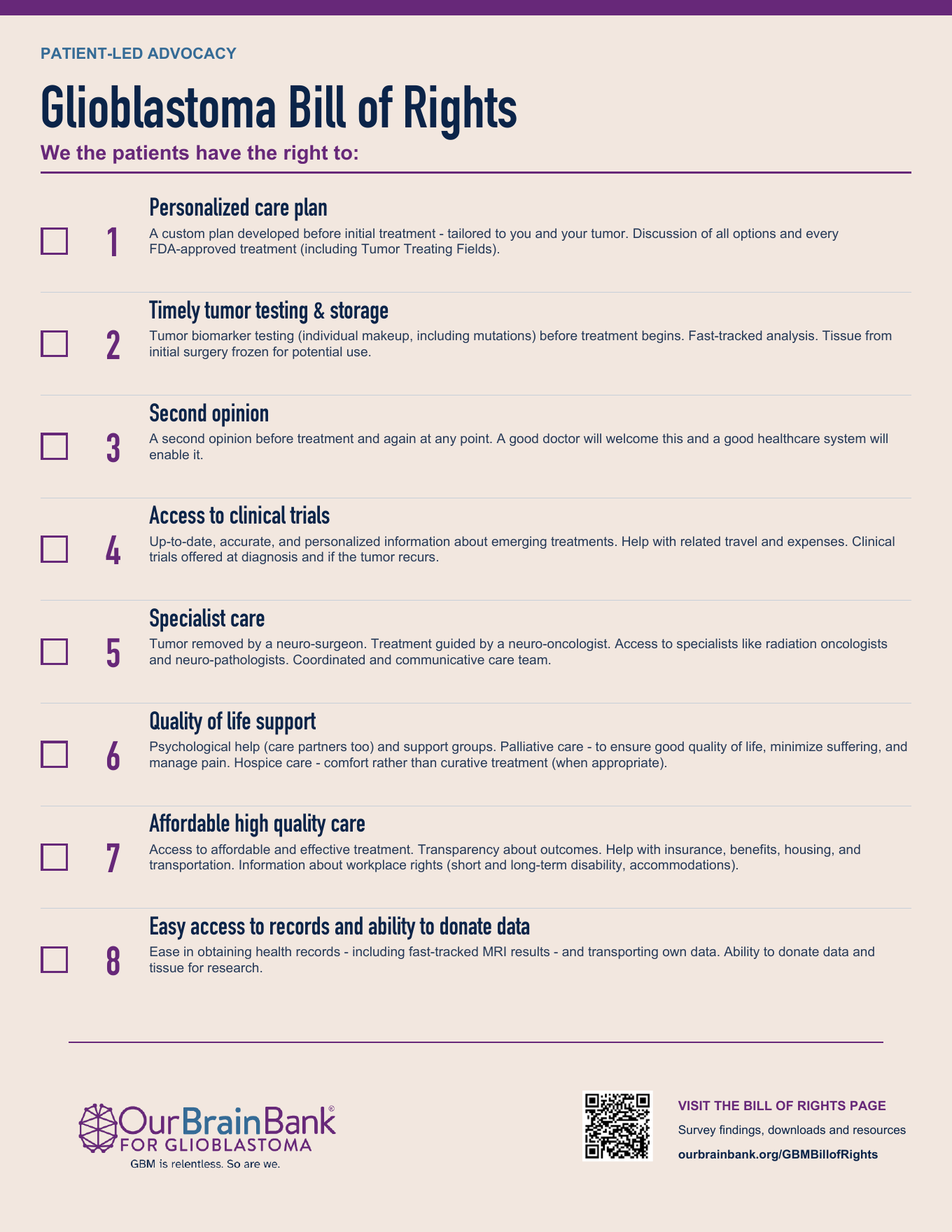
Download the checklist to print and take to your appointments.
In the lead-up to the first Glioblastoma Awareness Day 2019, OurBrainBank surveyed hundreds of GBM patients and carers about their experiences. OurBrainBank, with the help of fellow advocates, used the results to craft a set of concepts — some practical, some aspirational — to call for improving the standard of care and quality of life of GBM patients.
The original Bill of Rights launched in 2020. It was developed by OurBrainBank staff and members of our community, with input from nonprofit partners and medical advisors.
A separate national survey of 525 patients and care partners highlighted continuing gaps in care. Those findings informed the May 2026 revision and point to questions patients can raise with their care teams.
Ask your care teamWhich clinical trials could be appropriate for me now or if my tumor returns?
Ask your care teamHow can I arrange a second opinion before treatment or when my options change?
Ask your care teamWas tissue from my surgery stored, and how can I find out whether it is available?
Ask your care teamWhat testing was done on my tumor, and can we review the results together?
Stay connected with OurBrainBank news, research updates, events, and opportunities to take action.
Tell us how you’d like to support OurBrainBank, share your expertise, or become part of our community.